SUBMISSION
EDITORIAL
POLICIES
JOURNAL INFORMATION
JOURNAL TEMPLATE

RESEARCH TOOLS


The Journal applies a double-anonymized peer-review process to ensure fair, objective, and independent evaluation of submitted manuscripts. The identities of authors are not disclosed to reviewers, and the identities of reviewers are not disclosed to authors.
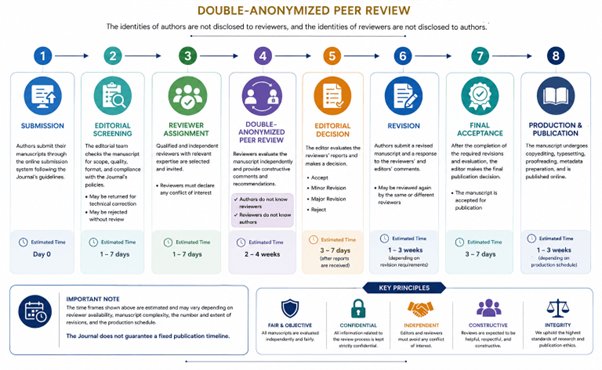
Authors submit their manuscripts through the Journal's online submission system. The submission must comply with the Journal's Author Guidelines and Submission Checklist.
The editorial team conducts an initial assessment to determine whether the manuscript:
· fits the Journal's Focus and Scope;
· meets the basic technical and formatting requirements;
· demonstrates sufficient academic relevance and quality; and
· complies with the Journal's publication and research integrity policies.
Manuscripts that do not meet the basic requirements may be returned to the authors for correction or rejected without external peer review.
Manuscripts that pass the initial screening are assigned to qualified and independent reviewers with relevant expertise.
Reviewers are selected based on their academic expertise and must disclose any actual or potential conflict of interest.
The Journal uses a double-anonymized peer-review model.
Under this model:
· authors do not know the identities of the reviewers;
· reviewers do not know the identities of the authors; and
· reviewer reports and editorial communications are handled confidentially.
Reviewers evaluate manuscripts objectively and provide constructive comments and recommendations to the editor.
After receiving the reviewer reports, the editor evaluates the manuscript and the reviewers' recommendations.
The possible editorial decisions are:
· Accept
· Minor Revision
· Major Revision
· Reject
Reviewer recommendations are an important part of the editorial assessment, but the final decision rests with the Editor-in-Chief or an authorized editor.
If revision is required, authors must submit a revised manuscript together with a response explaining how the reviewers' and editors' comments have been addressed.
A revised manuscript may be returned to the reviewers for further evaluation when necessary.
Following the completion of the required revisions and evaluation, the editor makes the final publication decision.
An accepted manuscript proceeds to the production stage.
Accepted manuscripts undergo the necessary production processes, which may include copyediting, typesetting, proofreading, metadata preparation, and online publication.
The Journal aims to process manuscripts efficiently while maintaining rigorous academic standards. The following timeframes are indicative estimates and are not guaranteed:
|
Stage |
Estimated Time |
|
Editorial Screening |
1–7 days |
|
Reviewer Assignment |
1–7 days |
|
Peer Review |
2–4 weeks |
|
Editorial Decision |
3–7 days after reports are received |
|
Author Revision |
1–3 weeks, depending on revision requirements |
|
Re-review, if required |
1–3 weeks |
|
Final Editorial Decision |
3–7 days |
|
Production and Publication |
1–3 weeks |
The overall time from submission to publication may vary depending on reviewer availability, manuscript complexity, the number and extent of revisions, and the production schedule.
The Journal does not guarantee a fixed publication timeline.
Reviewers may consider:
· originality and significance;
· relevance to the Journal's scope;
· clarity of research objectives;
· methodological rigor;
· quality of analysis;
· validity and clarity of findings;
· quality of discussion;
· appropriateness of conclusions;
· scholarly contribution; and
· compliance with research and publication ethics.
Manuscripts, reviewer reports, and communications related to the review process are treated as confidential.
Reviewers and editors must not disclose or use unpublished information obtained during the review process for personal or professional purposes.
Reviewers and editors must disclose any actual, potential, or perceived conflict of interest. A reviewer with a relevant conflict should decline the assignment.
The Journal may reassign a manuscript when necessary to maintain an independent and fair review process.
Authors may appeal an editorial decision when they believe that a significant procedural error or serious misunderstanding has affected the decision.
Appeals must provide a clear and substantive explanation and will be considered in accordance with the Journal's Editorial Policies.